> For the complete documentation index, see [llms.txt](https://docs.monogoto.io/llms.txt). Markdown versions of documentation pages are available by appending `.md` to page URLs; this page is available as [Markdown](https://docs.monogoto.io/getting-started/general-device-configurations/iot-devices/murata-lbad0xx1sc-dm.md).
# Murata LBAD0XX1SC-DM
The following guide contains AT commands guides for cellular modem Murata LBAD0XX1SC-DM working with Monogoto SIM card
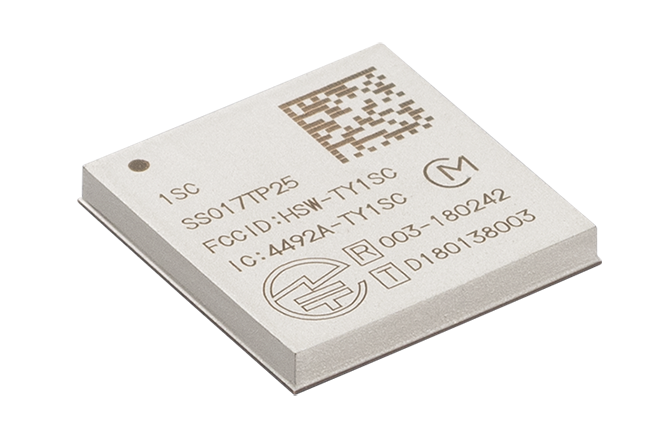
[**Murata LBAD0XX1SC-DM**](https://www.murata.com/en-us/products/connectivitymodule/lpwa/overview/lineup/type-1sc) The Type 1SC module is the world’s smallest Cat. M1/NB-IoT module with global certification. It supports GPS/GNSS, OpenMCU, and Integrated SIMS.
Murata LBAD0XX1SC-DM
### Prerequisites
* Monogoto SIM
* [LBAD0XX1SC-DM](https://www.murata.com/en-us/products/connectivitymodule/lpwa/overview/lineup/type-1sc)
### Quick Navigation
* [Test the connection by sending a PING](#test-the-connection-by-sending-a-ping)
* [Useful Links](#useful-links)
## Connect the LBAD0XX1SC to Monogoto
{% hint style="info" %}
Keep the **AT Commands manual** next to you for more details about the commands. [**Click here**](https://www.murata.com/en-us/products/connectivitymodule/lpwa/overview/lineup/type-1sc) to download the latest version, and scroll down to **Documentation and Resources** to find the AT Commands Manual.
{% endhint %}
**Define the Cat-M1**
```
at%ratimgsel=1
```
#### **Reset the Module**:
Reset non-volatile memory:
Reboot module:
```bash
ATZ
```
**Set the error reporting to verbose**, resulting in more descriptive error messages (optional):
```bash
AT+CMEE=2
```
Check the **status of the SIM card**. The correct response should be: `+CPIN: READY`
```
AT+CPIN?
```
{% hint style="warning" %}
If you receive an error, the SIM may not be inserted properly or the SIM is protected with a PIN. By default, Monogoto SIMs are not PIN-protected.
{% endhint %}
### Query device information
Request the **product type, hardware,** and **firmware** **version**:
```bash
ATI
```
Request the **IMSI** (International Mobile Subscriber Identity):
```
AT+CIMI
```
### Network Configuration
It is possible to let the modem select the network automatically, or to manually define a network to connect with.
#### **Option 1: Automatic Network Selection**
To set the modem to **automatic network selection** enter the command:
```bash
AT+COPS=0
```
Check the **network and cellular technology the modem** is currently using:
```
AT+COPS?
```
Expected response: `+COPS: 0,0,"",X`. The last digit indicates the cellular technology:\
7 indicates **LTE Cat-M1**\
8 indicates **NB-IoT**
#### Option 2: Manual Network Selection
Start with searching for available networks:
```
AT+COPS=?
```
{% hint style="warning" %}
It may take several minutes before the modem responds.
{% endhint %}
The modem responds with the **names** and the **MCCMNC** codes of the available networks. It also shows the cellular technologies the networks support:
```
+COPS: (1,"vodafone NL","voda NL","20404",8),(1,"NL KPN","NL KPN","20408",0),(1,"vodafone NL","voda NL","20404",9),(1,"T-Mobile NL","TMO NL","20416",0),(1,"NL KPN","NL KPN","20408",8),(1,"vodafone NL","voda NL","20404",0),(1,"T-Mobile NL","TMO NL","20416",8),(1,"T-Mobile NL","TMO NL","20416",9),,(0,1,2,3,4),(0,1,2)
OK
```
To find which of the networks Monogoto has **roaming agreements** with, review the [**Coverage lists**](/getting-started/global-public-coverage.md).
{% hint style="info" %}
To find the **profile** of your SIM, visit the [**Monogoto Console**](https://console.monogoto.io/), open the page **Things**  and select a specific **Thing**. Scroll down to **Mobile Identities** to find your profile in the column **Network Provider Name**.

{% endhint %}
Check the **network and cellular technology** the modem is currently using:
```
AT+COPS?
```
Expected response: `+COPS: 0,0,"",X`. The last digit indicates the cellular technology.
**Manually set the network and the cellular technology**:
```
AT+COPS=1,2,"XXXXX",7
```
Replace `XXXXX` with the **MCCMNC** code of your operator, for example`"20404"` for Vodafone NL. Use `7` for LTE Cat-M1.
**Check the radio signal strength and signal quality:**
```bash
AT+CSQ
```
{% hint style="info" %}
`+CSQ` returns 2 values separated by a comma. The first value represents the **signal strength** and provides a value between 0 and 31; higher numbers indicate better signal strength. The second value represents the **signal quality** indicated by a value between 0 and 7. If `AT+CSQ` returns `99,99`, the signal is undetectable or unknown.
{% endhint %}
#### Define the cellular band(s) (optional)
It is possible to **lock the modem to one or more specific bands**. This may result in a faster boot cycle as the modem does not need to scan for available bands at startup.
{% hint style="info" %}
Support LTE Band: Low Bands 5,8,12,13,14 (CAT M1 Only),17,18,19,20,26,28
Mid Bands 1,2,3,4,25
{% endhint %}
{% hint style="warning" %}
Although the modem may support many different bands, your local network operator may not. Have a look at the [**LTE Cat-M1 overview**](broken://pages/GDSRxI85QWE6Z2lsLeS3) to find the available band(s) in your region.
{% endhint %}
To lock the modem to a specific band, a hexadecimal value representing the band needs to be sent to the modem. To **lock the modem to LTE-M band 5**, send:
```
AT%SETCFG="BAND","5"
```
{% hint style="info" %}
For information about setting specific LTE bands, see **Murata LBAD0XX1SC-DM**
**AT Commands Manual**, chapter **4.2.5.**
{% endhint %}
To test if the band(s) is properly set, enter the command:
```
AT%GETCFG="BAND"
```
Example response: Bands: 1 ,2 ,3 ,4 ,5 ,8 ,12 ,13 ,14 ,17 ,18 ,19 ,20 ,25 ,26 ,28\
They represent the LTE-M bands and NB-IoT bands.
#### Query Network information
To information about the technology used, the network provider, and the cellular band, enter:
```
AT+QNWINFO
```
Example response: `+QNWINFO: "eMTC","20408","LTE BAND 20",6400`.
### Network Activation
**Set the APN to** `data.mono`:
```json
AT+CGDCONT=1,"IP","data.mono"
```
Validate if the **APN** is set correctly:
```
AT+CGDCONT?
```
Expected response: `+CGDCONT: 1,"IP","data.mono","0.0.0.0",0,0,0,0,0,0`
**Activate the PDP (packet data protocol) context**:
```
AT+CGACT=1,1
```
**Test** if the PDP context is activated:
```
AT+CGACT?
```
Expected response: `+CGACT: 1,1`
#### Validate if your device received an **IP address**:
```bash
AT+CGPADDR
```
Expected response: `+CGPADDR: 1,XX.XXX.XX.XXX`
{% hint style="info" %}
Do you see an IP address? **Congratulations! You’ve successfully connected the Murata LBAD0XX1SC-DM modem to Monogoto 🎉**
{% endhint %}
## Test the connection by sending a PING
A PING test can be performed to test if the modem has an active data connection with a mobile network.
{% hint style="warning" %}
When cellular modems are idle for a long period of time, cell towers might drop the data connection to save resources. Sending regular PINGs is a good method for testing the data connection, as well as for keeping the connection alive because the operator registers your device as being actively used.
{% endhint %}
**Send 5 PINGs** to the IP address `8.8.8.8`:
```
AT%PINGCMD=0,"8.8.8.8",5
```
Example response:
```
+QPING: 0,"8.8.8.8",32,543,255
+QPING: 0,"8.8.8.8",32,396,255
+QPING: 0,"8.8.8.8",32,262,255
+QPING: 0,"8.8.8.8",32,299,255
+QPING: 0,4,4,0,262,543,375
```
{% hint style="success" %}
**Great work on connecting the Murata LBAD0XX1SC-DM to Monogoto!** Have a look at the **Things** logs in the [**Monogoto Console**](https://console.monogoto.io/) to find more details about the established connection.
{% endhint %}
## Useful Links
* [QLBAD0XX1SC-DM product page](https://www.murata.com/en-us/products/connectivitymodule/lpwa/overview/lineup/type-1sc#anchor-3)
* [QLBADXX1SC-DM Quick Start Guide](https://3922449203-files.gitbook.io/~/files/v0/b/gitbook-x-prod.appspot.com/o/spaces%2F-M0mPxGpottOEfcucXOR%2Fuploads%2FIQSItX6iyZ35t7a1wnVf%2FLPWA%20Type%201SC%20Quick%20start%20guide_Ver3%201.pdf?alt=media\&token=f8493020-a0a8-4e34-afb8-246540645017)
* [QLBADXX1SC-DM DataSheet](https://wireless.murata.com/pub/RFM/data/lbad0xx1sc.pdf)